Fullscreen 60 FPS capacity
16.5987 ms p95
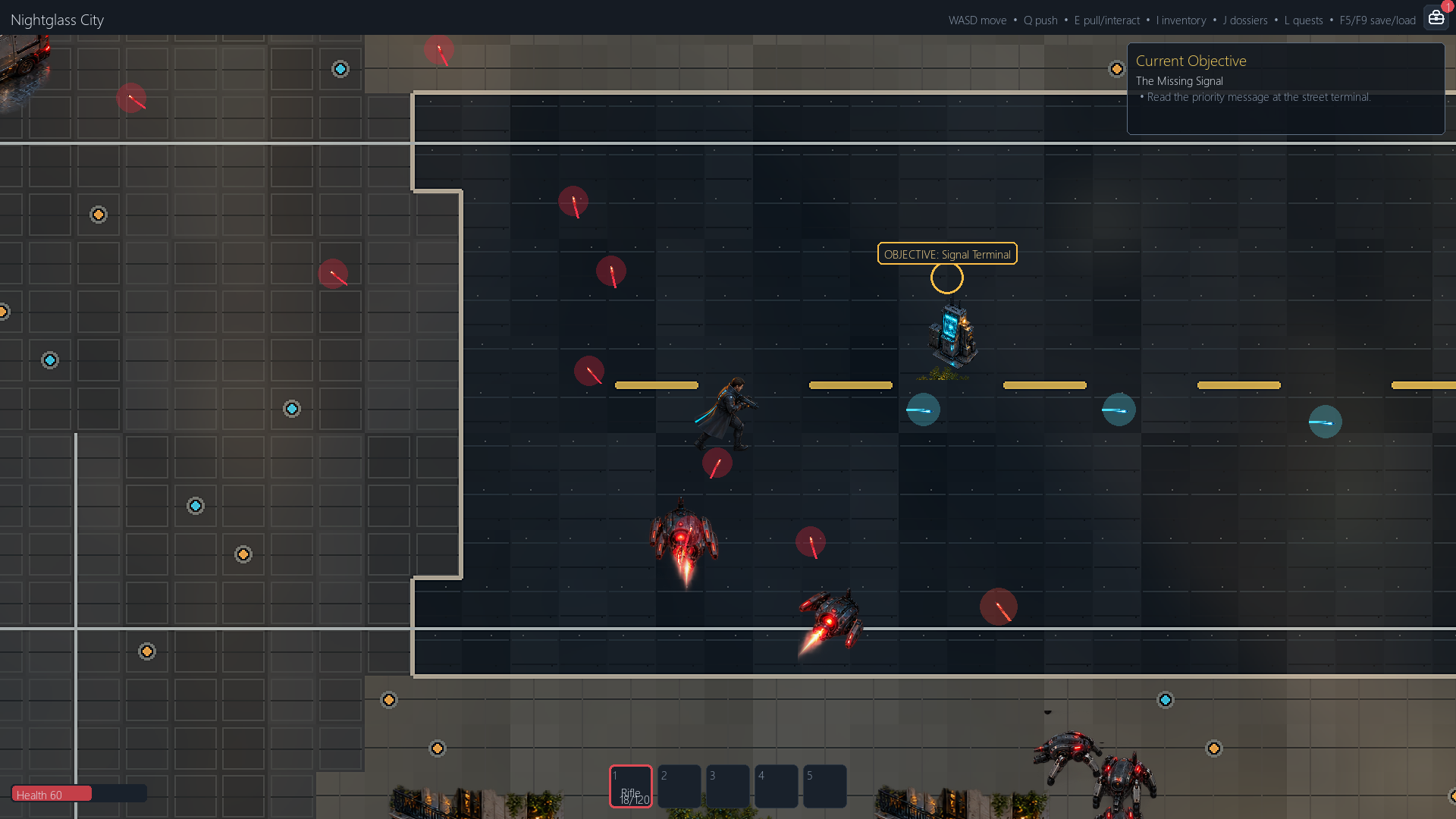
The 30-second 1920×1080 run stays inside the 16.6667 ms frame budget while the player travels 70.575 cells.
Desuper is a 2D runtime built around smooth gameplay, scalable worlds and deterministic simulation. The latest measurements show how the engine behaves under mixed loads containing world geometry, AI, scripts, collision queries, physical projectiles and rendering work.
Nightglass is a connected top-down qualification project built through the same Desuper project model used by the editor and exported runtime. Its measured route combines a cell-accurate city, directional actors, enemies, projectiles, combat effects, a mission, linked locations, staged loading and GPU presentation.
The 30-second 1920×1080 run stays inside the 16.6667 ms frame budget while the player travels 70.575 cells.
Only 26 of 1,566 measured frames cross the target. This is below Desuper's strict 2% limit.
The rendering lane retains ample room inside the 60 FPS frame while the connected encounter remains active.
One renderer creation and zero device recoveries during the measured route.
| Same authored floor | Frame p95 | Late frames | GPU texture peak | Process peak | Maximum frame |
|---|---|---|---|---|---|
| 25-source production layout | 16.5987 ms | 1.66% | 87.062 MiB | 574.414 MiB | 48.193 ms |
| Single 5120px boundary | 16.6002 ms | 2.41% | 454.217 MiB | 2,059.172 MiB | 904.639 ms |
A canonical 634×632-cell project is opened, panned, zoomed, searched, selected, edited, saved and reopened through the actual Level Design workspace.
The identical route falls from 8.63 seconds to 0.331 seconds by updating only changed data instead of rebuilding the world.
Selection falls from 2.82 seconds to 0.300 seconds while keeping the object fully editable.
Working set falls from 556.2 to 371.0 MiB on the measured Windows reference system.
Measured through the complete SDL3/Direct3D 12 gameplay frame at 1920×1080.
Only 0.45% crossed the exact 16.6667 ms frame budget in the latest run.
The extreme matched route now passes the 60 FPS percentile capacity gate.
Bounded growth during the retained mixed-runtime memory window.
Grid-based candidate queries keep movement, collision, visibility and projectile tests away from full-world scans while exact collision remains authoritative.
Perception and decisions use deterministic think budgets while movement and critical combat state remain responsive every frame.
Only relevant candidates enter the draw route. Safe static layers are reused as bounded world chunks while dynamic artwork retains exact ordered rendering.
Versioned precomputed data and reusable indexes move expensive setup into controlled loading phases instead of active gameplay frames.
Long AI routes retain exact collision checks but skip empty pixel ranges, keeping enemies practical across complete worlds instead of one small arena.
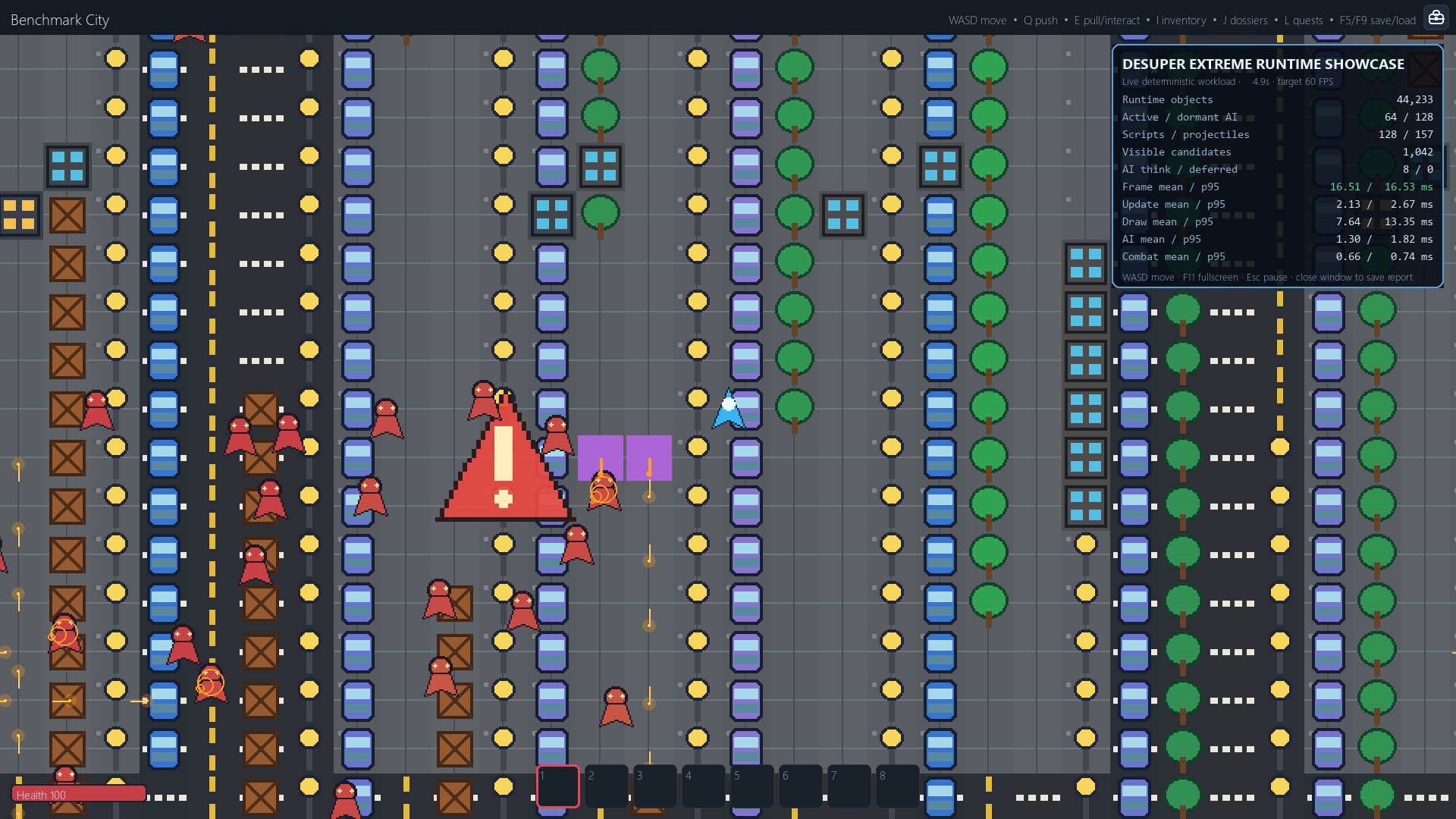
The latest Heavy run contains 44,233 objects per level, 64 active AI agents, 128 concurrent scripts and eight encounter districts spread across the world.
16.7179 ms mean, 16.5458 ms p95 and 16.5488 ms p99. One separately reported 366.8879 ms frame contains the cold level transition and remains an open loading/lifecycle target.
Update: 3.6545 ms
Rendering: 10.7923 ms
AI: 2.2988 ms
Combat and projectiles: 1.4694 ms
High-precision pacing, spatial broad phases, deterministic AI budgets, viewport culling, bounded visual chunks, pooled projectiles and indexed script-event dispatch.
| Test tier | Measured workload | Frame evidence | Meaning |
|---|---|---|---|
| Complete-frame SDL3 Heavy | 1920×1080 · 44,233 objects · 64 active AI · 128 scripts · 206 projectiles p95 | 16.5315 ms frame p95 · 16.5348 ms p99 · 10.4878 ms draw · 1.8288 ms AI | Gameplay pass |
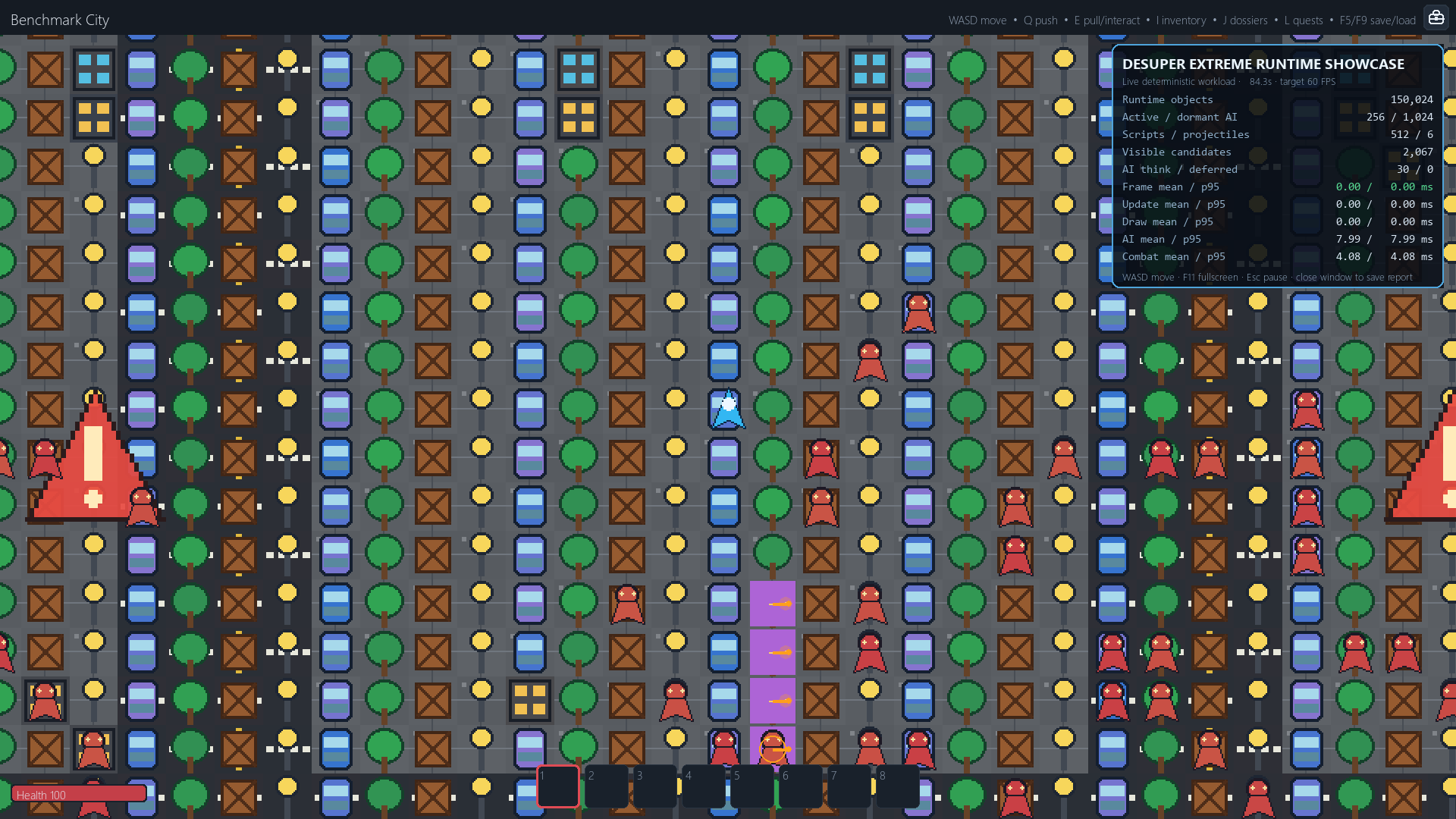
| Matched complete-frame SDL3 150K | 1920×1080 · 150,024 objects · 256 active + 1,024 dormant AI · 512 scripts · 61.131 cells travelled | 16.0018 ms frame p95 · 19.0190 ms p99 · 21.5998 ms max · 2.58% late | P95 capacity pass |
| Cold world transition | Populated City → Desert level switch | 352.6939 ms · explicitly retained lifecycle outlier | Open loading gate |
| 150K headless | 150,000 objects · 256 active AI · 1,024 dormant AI · 512 scripts · 956 projectiles max | 20.2159 ms frame p95 · 13.0607 ms update · 7.2875 ms draw | Capacity diagnostic |
| 150K fullscreen distributed | 1920×1080 · 150,024 objects · 8 districts · real player/camera movement | 32.8852 ms frame p95 · 23.2996 ms draw · 7.8200 ms AI | Fullscreen diagnostic |
| 10K world breaker | 311,257 objects · 1,000 active AI · 10,000 dormant AI · 5,000 scripts · 10,000 × 10,000 cells | 88.0248 ms frame p95 · world remained operational | Survivability ceiling |
The tiers have different acceptance purposes. A diagnostic or breaker result is never relabeled as a playable 60 FPS result.
The player moves through a populated 320×320 city and desert. Each level contains 44,233 stored objects and uses a different visual theme instead of repeating one empty laboratory scene.
Eight enemy groups are placed along the route and in surrounding districts. Patrol and pursuing enemies are therefore encountered throughout the world—not only at one hand-picked benchmark location.
The runtime player travels 118.714 measured cells around a 96-cell planned route while the fullscreen camera crosses world-chunk boundaries.
AI, pathfinding, collision, visibility, 128 scripts, 16 spawners, hazards, combat zones and hundreds of physical projectiles run together.
About 1,092 candidates are visible at p95. Safe static art is represented by 48 reusable chunk draws at p95, while enemies, projectiles and effects remain dynamic.
Continuous Heavy gameplay is smooth, but the cold City → Desert switch still takes 352.6939 ms. It is reported openly as the next loading/lifecycle target.
A 97.7% reduction on the same distributed Heavy world.
A 96.3% reduction while keeping exact collision and distributed enemies.
An 85.3% reduction without reducing object, AI or script counts.
Long AI routes still use pixel-precise obstacle testing, but exact mask checks occur only inside intervals that can actually contain a blocker. Empty world space no longer consumes thousands of pixel checks per route.
| Lane | Mean | p95 | p99 / maximum | Interpretation |
|---|---|---|---|---|
| Complete frame | 16.7179 ms | 16.5458 ms | 16.5488 / 366.8879 ms | The maximum contains the separately measured cold level switch. |
| Gameplay update | 2.7638 ms | 3.6545 ms | 4.4401 / 9.9438 ms | Simulation remains well below its 10 ms p95 contract. |
| Drawing | 6.0705 ms | 10.7923 ms | 11.6907 / 22.4493 ms | Largest normal Heavy lane; still below the 12.5 ms p95 draw gate. |
| Enemy AI | 1.4796 ms | 2.2988 ms | 3.1061 / 9.2336 ms | Includes perception, patrol/pursuit, route tests, bounded A* and motion. |
| Combat/projectiles | 1.1180 ms | 1.4694 ms | 1.5479 / 1.7251 ms | Physical projectile and effect processing remains bounded. |
| DesuperCode | 0.0905 ms | 0.1348 ms | 0.1535 / 0.1669 ms | 128 concurrent script runtimes and timers. |
| Presentation | 0.6743 ms | 0.7726 ms | 0.8253 / 0.9083 ms | Display submission remains stable. |
| Frame wait | 7.0033 ms | 8.4056 ms | 8.8012 / 9.6392 ms | Positive wait time shows remaining headroom in most Heavy frames. |
| Workload counter | Mean | p95 | Maximum |
|---|---|---|---|
| Visible candidates | 1,061.278 | 1,092 | 1,093 |
| Static visual chunk draws | 42.158 | 48 | 48 |
| Static sources represented by chunks | 1,087.240 | 1,233 | 1,241 |
| Physical projectiles | 197.770 | 272 | 278 |
| Weapon effects | 66.203 | 78 | 89 |
| AI think updates per frame | 8.029 | 12 | 22 |
| AI direct-route checks per frame | 3.876 | 9 | 14 |
| A* nodes expanded per frame | 48.499 | 345 | 1,013 |
| Lane | Mean | p95 | p99 / maximum | What it reveals |
|---|---|---|---|---|
| Complete frame | 27.8262 ms | 32.8852 ms | 35.6172 / 359.3175 ms | About 36 FPS by mean frame time; not a 60 FPS pass. |
| Gameplay update | 8.8207 ms | 10.3603 ms | 11.5273 / 14.1626 ms | Much lower than the earlier 67.1127 ms p95, but just above the strict update budget. |
| Drawing | 18.3513 ms | 23.2996 ms | 25.3536 / 349.0150 ms | The largest current 150K lane and the next render-backend target. |
| Enemy AI | 6.1956 ms | 7.8200 ms | 8.7113 / 12.6383 ms | 256 active agents distributed across eight districts. |
| Combat/projectiles | 2.1707 ms | 2.8490 ms | 3.0681 / 3.5835 ms | Hundreds of physical projectiles remain active. |
| DesuperCode | 0.3730 ms | 0.4717 ms | 0.5542 / 0.7514 ms | 512 script runtimes and timers. |
2,319 candidates p95, 48 chunk draws p95 and 2,438 static chunk sources p95.
73 think updates, 44 direct routes and 751 expanded A* nodes at p95; 1,698 nodes maximum.
413 physical projectiles p95 and 426 maximum, plus 156 weapon effects p95.
5,560.2921 ms total: 275.5559 ms prepared decode, 18.2389 ms navigation cells and 1,464.2102 ms first-level index construction.
Ninety-five percent of recorded samples complete at or below this duration. It reflects sustained smoothness better than one peak FPS number.
Ninety-nine percent complete at or below this duration. It makes less frequent hitches visible.
The single slowest sample is retained. A loading transition can create a high maximum even when normal gameplay p95 is stable.
A very small number of extremely slow lifecycle frames can pull the arithmetic mean upward while leaving the 95th percentile near the normal gameplay cluster.
AI, drawing and combat p95 values must not be added together: their slowest five-percent windows may occur on different frames.
These figures describe one unclassified Windows system. They are development evidence, not final minimum or recommended specifications.
Heavy asks whether a demanding, realistically structured 2D world can remain smooth. The 150K tier asks where scaling pressure appears. The 10K-world breaker asks whether the architecture remains bounded and operational far beyond a normal scene.
Placing 150,000 objects in one active world is intentionally excessive. That does not invalidate the result; it isolates limits in rendering, AI scheduling, indexing and loading before a real project reaches them unexpectedly.
An optimization is compared against the same workload, movement route, resolution and system counts. Object counts cannot simply be removed to manufacture a faster result. Exact collision and safe rendering fallbacks must continue to pass.
If an engine remains stable well above a normal project's expected load, creators gain room for effects, AI spikes, busier encounters and lower-spec computers. The extreme tier is used to build that safety margin.
A non-pass identifies the next engineering target. The latest 150K result shows that drawing is now more expensive than AI, while the City → Desert test shows that cold index preparation—not continuous gameplay—is the transition bottleneck.
These figures cannot fairly rank Desuper against another engine unless both use equivalent content, code, hardware, resolution and measurement rules. They describe Desuper's own verified development state.
| Evidence tier | Question it answers | What users should expect | What it does not claim |
|---|---|---|---|
| Distributed Heavy | Can a demanding authored top-down world sustain smooth fullscreen play? | Strong current evidence for large 2D levels with distributed enemies, scripts, combat and dense scenery on the measured PC. | Not a minimum-spec guarantee for every computer or every possible game combination. |
| 150K breaker | Which subsystem becomes the next bottleneck when one world is intentionally overloaded? | Stable operation at an extreme scale; current optimization priority is CPU-side drawing. | Not a recommended object count, level layout or 60 FPS promise. |
| 10K-world breaker | Do sparse indexing and bounded scheduling survive a huge addressable world? | Architectural survivability evidence and data for future streaming work. | Not playable-performance evidence at that complete active load. |
| Lifecycle tests | Do loading, transitions and window/device events remain controlled? | Transparent reporting of cold-transition and recovery costs. | A good gameplay p95 does not automatically mean every lifecycle gate has passed. |
Reports retain mean, p95, p99, maximum frame time and exact deadline misses. This exposes isolated stalls that a single average-FPS number would conceal.
Event handling, update, drawing, presentation, AI, scripts, combat and frame waiting are measured separately so optimization targets come from evidence.
Before/after runs preserve workload sizes and gameplay semantics. Exact collision and ordered-render fallbacks remain authoritative when an optimized path is unsafe.
The latest focused and combined routes pass 28/28 and 47/47, covering runtime behavior, visual-chunk correctness, profiler evidence, showcase launching and game export behavior.
Current capacity figures come from one unclassified Windows system. Tests on low-, reference- and high-tier hardware remain required before minimum specifications can be published.
Slow event batches now retain their responsible event names. The latest visible run recorded no event outlier, but resize, alt-tab, transitions and packaged builds still require a full matrix.
| Measured lane | Initial retained direct route | Current optimized route | Reduction |
|---|---|---|---|
| Frame p95 | 67.6674 ms | 20.2159 ms | 70.1% |
| Mean frame | 42.9334 ms | 17.2466 ms | 59.8% |
| Update p95 | 52.8881 ms | 13.0607 ms | 75.3% |
| AI p95 | 27.2861 ms | 4.8405 ms | 82.3% |
| Combat/projectiles p95 | 28.7261 ms | 8.6850 ms | 69.8% |
| Draw p95 | 15.4349 ms | 7.2875 ms | 52.8% |
At 60 FPS, the complete event, simulation, rendering and presentation path has approximately 16.6667 ms. At 120 FPS this falls to 8.3333 ms.
The 95th-percentile frame is slower than 95% of measured frames. It is a more useful smoothness indicator than an average alone.
These expose rare tail stalls. A strong p95 can coexist with a visible isolated hitch, which is why Desuper retains all three values.
The Heavy gate counts frames crossing the exact target budget. The latest run missed only 1 of 901 deadlines.
| Evidence window | Measured result | Interpretation |
|---|---|---|
| Static 60 FPS pacing | 7 exact misses across 1,802 frames | Precise fractional pacing verified |
| Static 120 FPS pacing | 13 exact misses across 3,602 frames | 8.3333 ms target pacing verified |
| Heavy startup | 1,441.2363 ms total · 25.0806 ms visible-chunk prewarm | Preparation remains outside active gameplay |
| Visible 150K startup | 4,744.3079 ms total · 28.5566 ms visible-chunk prewarm | Extreme workload loading evidence |
| Visible event handling | 0.0131 ms p95 · 0.4892 ms maximum · no ≥25 ms outlier | Clean repeat; lifecycle matrix still open |
| Mixed-runtime memory | 0.82 MiB retained growth over 90 seconds | Bounded evidence window; extended soak still required |
Loading duration and gameplay frame time are deliberately reported separately. A larger world may take longer to prepare without causing the same delay during every active frame.
The engine can sustain the accepted Heavy synthetic workload at its 60 FPS gate, preserve exact fallbacks and survive substantially larger diagnostic worlds.
One computer cannot establish minimum specifications. GPU, driver, operating-system and background-load differences require a declared hardware matrix.
The 150K and 10K-world tiers intentionally exceed ordinary scenes. They identify scaling limits and optimization priorities rather than recommending those loads for every game.
Optimized routes retain exact collision checks, stable draw order and safe fallbacks. A faster result is rejected if behavior or rendered pixels change incorrectly.
Explicitly immutable world artwork is composed into reusable 256-pixel regions. The cache is bounded and old regions are evicted automatically.
The opening viewport is prepared during the loading phase instead of waiting for the first gameplay draw. Slow event batches now retain bounded diagnostic evidence rather than becoming unexplained frame spikes.
Only complete safe layers can use chunks. Animated, moving, scaled, rotated or mixed layers continue through the exact ordered fallback.
Visibility and animation changes invalidate the appropriate cached generation. Loading a save clears retained visual chunks.
Headless 150K draw p95 fell 45.3%; visible draw p95 fell 31.6%. Pixel-parity and 45 combined runtime/export/profiler checks pass.
One hundred million addressable cells in a sparse, indexed world.
250,000 distributed world objects, 50,000 dense objects, AI, spawners and the player state.
1,000 active AI, 10,000 dormant AI and 5,000 concurrent scripts, plus projectile and collision work.
A diagnostic survivability ceiling—not a playable performance target or minimum-spec claim.
Frame p95 while the real player traverses two populated worlds with 44,233 objects per level, 64 active AI agents across eight districts and 128 scripts.
Exact route checks focus on actual obstacle intervals; the latest Heavy non-regression remains inside its 60 FPS p95 gate without clustering enemies.
A deliberately extreme fullscreen engineering test. It is a scaling diagnostic, not an example of how a normal game developer should fill one visible scene.
Heavy is the closer representation of a demanding real game. The 150K tier intentionally exceeds ordinary scene composition to reveal the next engine bottleneck.
One hundred enemies start active and 900 more arrive in six timed waves while the player moves through a populated 1024×1024-cell world.
The p95 workload also includes 568 visible candidates, 256 scripts, collisions, effects and 14,089 runtime objects at 1920×1080 fullscreen.
Enemies are prepared in bounded pools, so a new wave does not decode assets or rebuild the complete world during active gameplay.
The extreme 1,000-enemy pressure point remains above the strict 16.6667 ms gate, but the measured optimization path raises mean throughput from 38.7 to approximately 48.9 FPS.
| 1080p horde metric | Initial route | Current route | Improvement |
|---|---|---|---|
| Frame p95 | 35.2225 ms | 25.2299 ms | 28.4% |
| Update p95 | 26.3716 ms | 18.5926 ms | 29.5% |
| AI p95 | 21.1580 ms | 13.5893 ms | 35.8% |
| Projectile p95 A/B | 5.9697 ms | 5.0301 ms | 15.7% |
Desuper now presents the complete gameplay frame through a persistent SDL3 3.4.16 / Direct3D 12 session on the reference Windows PC. The original atlas proof remains useful historical evidence; the latest Heavy and 150K results measure the complete frame.
SDL3 3.4.16 created a real GPU renderer on the reference Windows PC and presented through the existing game window.
Sixteen authored images were exported into one atlas page and submitted in their original alternating order.
The isolated 30-frame renderer lane used ten bounded draw calls and one resident texture upload.
Native Runtime Core geometry reduced one-time batch preparation from 347.5170 to 306.6787 ms.
| Exported-atlas renderer lane | Software fallback | SDL3 GPU | Status |
|---|---|---|---|
| Mean | 467.3299 ms | 6.4755 ms | Measured |
| p95 | 475.3559 ms | 7.0793 ms | 98.51% lower in this isolated breaker |
| Submission count | 150,000 surface blits | 10 bounded draw calls | Stable atlas reuse |
| Correctness | Authoritative fallback | Pixel/order/alpha parity | Automated |
Direct3D 12 is verified on one unclassified Windows PC. Vulkan, multiple declared hardware tiers, native GPU timing markers and extended packaged lifecycle/soak evidence remain qualification gates.
After removing a whole-world identity reconstruction, lifecycle telemetry exposed a second issue: dynamic visibility changes invalidated unrelated static chunks. Both causes are now removed.
Desuper's emerging rendering coordination layer keeps reusable world work resident, submits only relevant changes and avoids duplicated presentation. Its deeper architecture remains private while qualification continues.
The identical 150K route now reaches 16.0018 ms frame p95. Maximum frame time fell from 69.3721 to 21.5998 ms, with workload and visual quality retained.
The tested sparse world keeps creator-authored ownership without treating empty space as active gameplay work.
The project contains 512 active and 2,048 dormant enemies. Sixty-four enemies in the current combat district remain resident and simulated.
The fullscreen hybrid route stays inside the 60 FPS p95 budget and records only 8 late frames out of 720.
Full, reduced-rate and preload neighbourhoods keep distant world activity from consuming the local encounter budget.
The same 150,024-object engineering route now spends 10.0485 ms at the combined p95 boundary instead of 13.6102 ms.
AI/pathfinding p95 falls from 6.9094 to 3.9764 ms without removing any of the 256 active or 1,024 dormant enemies.
The accepted engineering run retains the complete object, script and projectile workload. A moving fullscreen confirmation is the next gate.
The newest fullscreen route moves a real player through the world while AI, scripts, projectiles, effects, collisions and the complete render path remain active. The graph uses a 40 ms scale; the white markers show the full 120 FPS and 60 FPS frame budgets.
150,024 objects, 256 active AI, 1,024 dormant AI, 512 scripts, 422 projectiles p95 and 79.963 cells travelled.
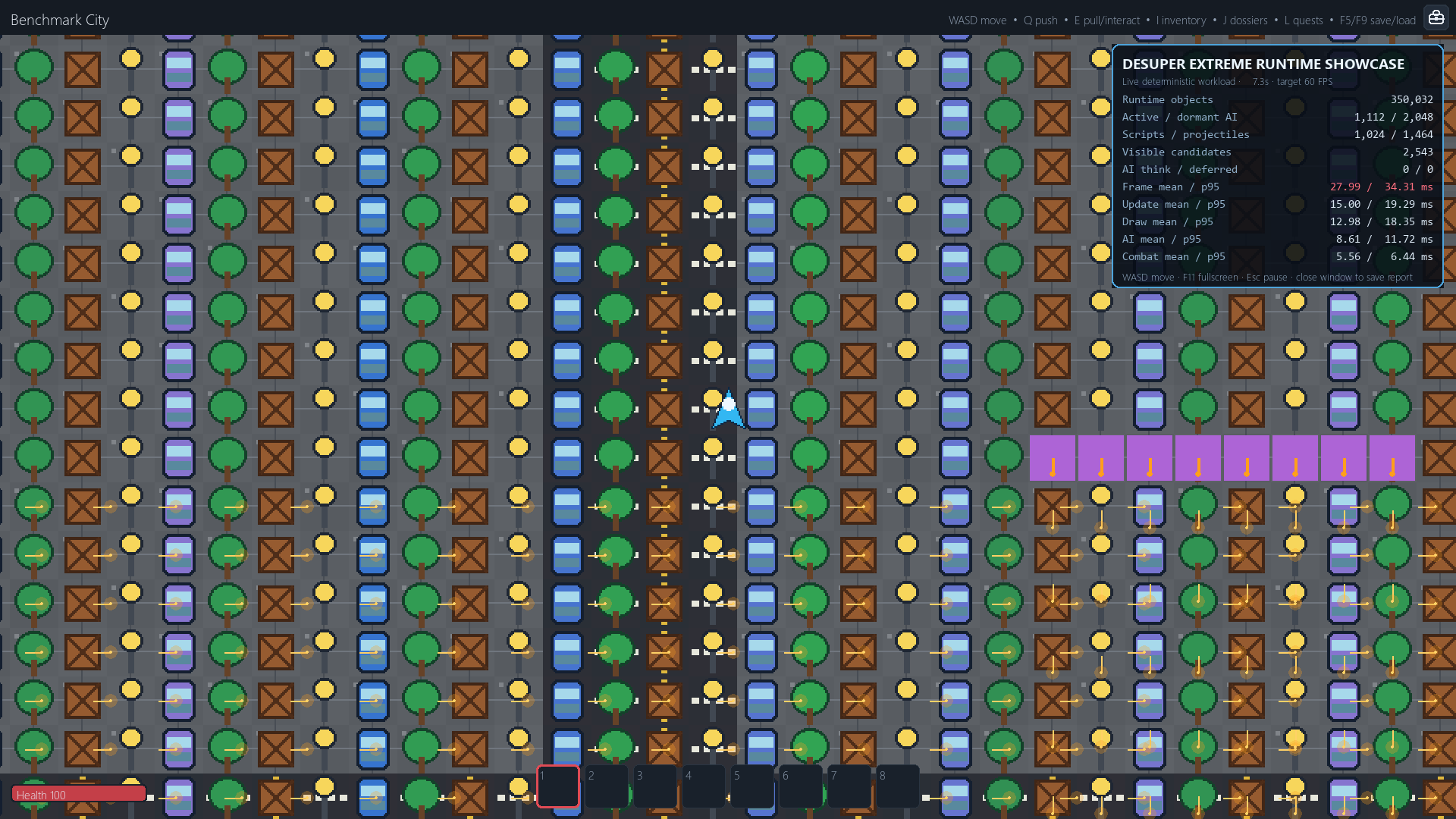
The exact 350,032-object survivor boundary before the latest resident-selection repair.
20.35% lower frame p95 with no object, enemy or projectile reduction. It remains above the 60 FPS target.
AI p95 falls from 15.6813 to 9.7527 ms; update p95 falls 29.15%.
Two 4096×4096 and ten 2048×2048 original RGBA sources across two distinct worlds.
Visible background, albedo, decal and sheet content plus preloaded normal, emissive and mask data.
Draw p95 rises from 35.0740 to 35.9471 ms. Frame p95 remains within run-to-run variation.
Peak process working set increases from 1,171 to 1,394 MiB, confirming why explicit texture budgets matter.
The final fullscreen route retains 150,024 objects, 900 activated horde enemies, hundreds of projectiles and real player travel.
Down from 29.9470 ms after stationary actors stopped paying synchronization and partition bookkeeping costs. This frontier remains above the 60 FPS target.
Runtime memory tiers now bound Desuper's decoded GPU texture residency. Current, peak and limit values are measured instead of guessed.
The high-resolution route stays below its 512 MiB reference-tier GPU texture limit.
These are controlled development measurements from one unclassified Windows computer. Heavy is the closest current approximation of a demanding real game world. The 150K and large-world breaker tiers deliberately exceed ordinary scene composition; they reveal scaling limits rather than recommending that developers place every world object in one viewport.
Distributed-world AI, texture-atlas metadata, loading-owned indexes, pooled survivor waves, persistent native batches, byte-bounded texture residency and complete-frame SDL3 presentation are implemented. Stable enemy state and region-aware selection remove measured CPU hot paths. The moving 150K route is green at the 60 FPS p95 boundary, and the connected Nightglass production route now also passes the strict pacing gate. The 350K frontier remains diagnostic. Production mip/LOD streaming, material shading, HLOD, occlusion and wider hardware qualification remain active engineering gates.